Friday, January 18, 2008

Man undergoes surgery for facial tumors

Huang Chuncai is seen on the operating table before his second operation to remove his tumours, which currently weigh around 10kg (22lbs), at a hospital in Guangzhou, southern China's Guangdong province January 7, 2008. Huang, a 32-year-old native from a remote village in China's southern province of Hunan, says he is relieved after a part of his facial tumours, which originally weighed about 23kg (50.7 lbs), was removed last year. His second operation will remove another part of the tumours, which weighs 4.5kg (9.9lbs). Huang suffers from neurofibromatosis, which is a genetic disorder of the nervous system that primarily affects the development and growth of nerve tissues.


Huang Chuncai sits in a wheelchair beside his sister before his second operation to remove his tumours, which currently weigh around 10kg (22lbs), at a hospital in Guangzhou, southern China's Guangdong province, January 5, 2008. Huang, a 32-year-old native from a remote village in China's southern province of Hunan, says he is relieved after a part of his facial tumours, which originally weighed about 23kg (50.7 lbs), was removed last year. His second operation will remove another part of the tumours, which weighs 4.5kg (9.9lbs). Huang suffers from Neurofibromatosis, which is a genetic disorder of the nervous system that primarily affects the development and growth of nerve tissues. Picture taken January 5, 2008.


Huang Chuncai cries before his second operation to remove his tumours, which currently weigh around 10kg (22lbs), at a hospital in Guangzhou, southern China's Guangdong province, January 5, 2008. Huang, a 32-year-old native from a remote village in China's southern province of Hunan, says he is relieved after a part of his facial tumours, which originally weighed about 23kg (50.7 lbs), was removed last year. His second operation will remove another part of the tumours, which weighs 4.5kg (9.9lbs). Huang suffers from Neurofibromatosis, which is a genetic disorder of the nervous system that primarily affects the development and growth of nerve tissues. Picture taken January 5, 2008.


Huang Chuncai poses before his second operation to remove his tumours, which currently weigh around 10kg (22lbs), at a hospital in Guangzhou, southern China's Guangdong province, January 3, 2008. Huang, a 32-year-old native from a remote village in China's southern province of Hunan, says he is relieved after a part of his facial tumours, which originally weighed about 23kg (50.7 lbs), was removed last year. His second operation will remove another part of the tumours, which weighs 4.5kg (9.9lbs). Huang suffers from Neurofibromatosis, which is a genetic disorder of the nervous system that primarily affects the development and growth of nerve tissues. Picture taken January 3, 2008.








Friday, January 11, 2008

Marion Jones sentenced to six months in prison

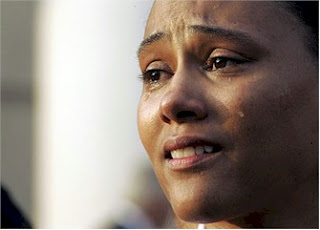
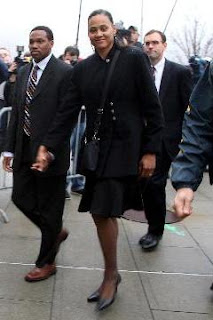
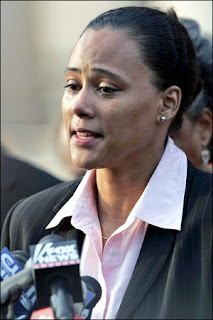
Marion Jones, the record-breaking sprinter who tearfully confessed she used steroids after years of public denial, was sentenced to six months in prison for lying in two federal grand jury investigations.

Jones, 32, pleaded guilty in October to two counts of obstruction of justice in federal court in White Plains, New York. The International Olympic Committee stripped her of the record five medals she won at the 2000 Games in Sydney after she admitted taking banned performance-enhancing substances.

She was the first athlete convicted in the almost five-year- old U.S. government investigation of steroids in sports. The sentence was ordered today by U.S. District Judge Kenneth Karas in White Plains, who said he had considered imposing more than the maximum six-month term recommended under Jones's plea bargain because her offenses involved two separate criminal probes.


Jones was charged with impeding a San Francisco steroid probe of the Bay Area Laboratory Co-Operative, or Balco, based in Burlingame, California, and a separate Manhattan investigation of a bad-check cashing scheme by fellow athlete Tim Montgomery. She argued she should receive only probation because she is the mother of two young boys.

In addition to pleading guilty to taking substances before the Sydney Olympics, Jones admitted lying about knowing that Montgomery deposited $200,000 in counterfeit checks in a bank account. She lived with Montgomery, the father of her older son, in 2005.


Biggest Sponsor


Nike Inc., the world's biggest maker of athletic apparel, was Jones's biggest sponsor at the time the drug use took place. The company, whose contract with Jones expired in 2005, said at the time of her plea that it was ``saddened, shocked and disappointed by the fact that, while we believed and trusted in Marion, we were also deceived.''

The IOC launched a probe of banned substance use in 2004 after reports in the San Francisco Chronicle and other media linked athletes including Jones to Balco's drug-distribution network.

Barry Bonds, Major League Baseball's all-time home-run leader, was indicted in November with perjury and obstruction of justice for lying to a grand jury about steroid use. Prosecutors said the outfielder told a panel in 2003 that he never knowingly used banned drugs, according to his indictment.

On Jan. 9, a U.S. House Committee postponed until next month a hearing on steroids in professional baseball and requested depositions from prospective witnesses, including All-Star pitchers Roger Clemens and Andy Pettitte.

Steroids in Baseball

Congress is returning to the issue of steroids in baseball following last month's report by former U.S. Senator George Mitchell, which linked more than 80 players including Pettitte and Clemens to performance-enhancing drugs. The same House committee held hearings in 2005 and urged a tougher drug policy for the sport.

Since the Mitchell report was released Dec. 13, Clemens has repeatedly denied charges made by his former trainer that he was injected with illegal drugs.

In the Jones case, the two-time world champion in the 100- meter sprint admitted at her October plea hearing that she took performance-enhancing drugs but didn't realize she had taken steroids until later, when her performance dropped off.

Prosecutors and defense lawyers told the judge Jan. 9 that the ex-track champion should be sentenced according to her plea deal with the government. The U.S. urged Karas to consider that Jones's false statements were three years apart and that her plea saved ``immeasurable time and resources.''

'Lost Everything'

Her lawyer, Henry DiPippo, wrote that ``Marion has already lost everything -- the only livelihood she has ever known, her professional accomplishments, her financial security, and her reputation -- all in the most public manner possible.''

Jones retired from competition after giving up her medals.

Jeff Novitzky, an agent with the U.S. Internal Revenue Service investigating the Balco case, said in court papers that Jones's name showed up in a Balco ledger. The lab's records contain a list of their ``client-athletes'' and results of urine tests for anabolic steroids and masking agents, he said.

Two pages of the ledger contain the name "Marion J.," indicating she took several performance-enhancing drugs including tetrahydrogestrinone, a lab-altered steroid known as THG or "the Clear," and the anabolic steroid Norbolethone known as "Nor," between September 2000 and June 2001, Novitzky said.

Federal agents also found a yellow manila folder labeled "Marion Jones" at a Balco storage facility in California, Novitzky said in court papers, with a monthly "doping" calendar Balco created for Jones between March and July 2001.

World Champion

In February 2006, Jones settled a $25 million defamation lawsuit against Victor Conte, the Balco founder. Conte, who claimed he supplied Jones with performance-enhancing drugs including THG, served a four-month jail term after pleading guilty to steroid distribution.

Jones was one of several athletes who testified four years ago before a grand jury probing Balco. Montgomery, a former world-record holder in the men's 100-meter sprint, was banned from the sport for two years because of steroid use. Trevor Graham, a former coach of Jones and Montgomery, faces trial in San Francisco federal court for lying to U.S. agents.

Jones admitted Graham gave her steroids before the 2000 Games and that she lied to federal agents in a 2003 interview, saying the former coach told her it was flaxseed oil.

Jones was listed in government filings in federal court in San Francisco as having testified before a grand jury investigating Graham. Also listed were Montgomery, sprinter Michelle Collins, brothers Alvin and Calvin Harrison and sprinter Ramon Clay.

Prosecutors said the athletes may be called as witnesses at Graham's trial.

The case is U.S. v. Marion Jones, 05-CR-1067, U.S. District Court, Southern District of New York (White Plains).

How to Seduce a Woman???

Have you ever looked at men who can get any girl they want and wondered, "how do they do it?" Yes, females are attracted to power and status. Yes, they are attracted to symmetrical features, strength and confidence. The art of distracting a woman from all of your shortcomings and making her fall in love with you for who you are is called seduction. But here you are going to watch an all new method to seduce a woman......

Thursday, January 10, 2008

Tata unveils Rs 1-lakh car 'Nano' .....

It's a hit!!!

Tata Motors, the country's largest automobile manufacturer on Thursday launched the eagerly awaited Rs one lakh car and christened it Tata Nano. The Rs one lakh car is touted as the world's cheapest mass-produced car from the stables of Tata Motors, the automotive arm of the over Rs three-trillion market value group. Rival car makers have, however, not been convinced about the safety and emission standards of the car, coming as it is at that price level.

The launch marks the realisation of a dream for Tata Sons Chairman Ratan Tata, who is looking forward to silencing critics of the project. The car is expected to fill the big gap between the cost of the average two-wheeler and entry-level cars such as the Maruti 800, which retails for about $5,000.

Dubbed till now as the 'people's car', Tata's faced numerous problems like a rising input cost, environmental concerns and stiff political opposition for setting up its manufacturing plant at Singur in West Bengal.


Experts, man on street give Nano 10 on 10

New Delhi: Nobody wanted to buy Ratan Tata's concept of a Rs 1-lakh-worth People's Car when he first talked of it. Some five years later, when Tata Motors finally unveiled the 'Nano', Tata's friends and foes are lapping up this tiny four-wheeler like their own.


The critics initially derided the concept mainly on the basis of the price target, more so as oil and steel prices rocketed. But Ratan Tata still kept his promise and delivered the Nano almost at his target price, forcing global car makers to take note. In fact, many top atomobile giants are now scurrying for their own versions to meet growing environmental and cost concerns.


The 'People's Car', which got critics and well-wishers all awestruck at Pragati Maidan on Thursday morning, is now not only being talked about as the 'future car'. Expert say it will also determine India's place in the global automotive arena and possibly give a leap to India's dream of becoming a global hub of small cars. The car, feel experts, is more than value for money with its 20 kmpl average and the smart price. Here are the first reactions of some of the most prominent industry experts as they told to CNN-IBN and various news agencies.

'Nano's launch is a proud moment for the country'

India must protect the interests of its auto industry from the impact of free trade pacts with other countries that allow imports at zero or reduced tariff, Heavy Industry Minister Sontosh Mohan Dev said on Thursday. "We have to see that a lot of free trade agreements that are being signed by India should not stand in the growth path of our automobile industry, as it is only 15-year-old," Dev told the inaugural event of Auto Expo 2008 here.

"If we do not do it, we will end up becoming net importers," the minister told the eight-day event, that was opened by his cabinet colleague and Commerce and Industry Minister Kamal Nath, which oversees the free trade pacts. "We also have to be globally competitive. If we were to be globally competitive, we need to achieve economies of scale. I want the industry to bear in mind this aspect so that when investment is made global competitiveness is first priority," he said.

"We are certainly much more economic in terms of infrastructure costs compared to Europe and North America, but we need to be more competitive with regard to the emerging economies by achieving higher productivity." The government, he said, has the stated objective of making the Indian auto sector a $145-billion industry by 2016 that will also see the creation of 25 million additional jobs. Kamal Nath assured those present at the occasion that the United Progressive Alliance government was, indeed, cautious in protecting the interests of its industry whenever required.

Indian Call Centre

This is a really funny clip espcially if you've ever spoken to someone in a call centre in india.